
Language of the day: Canadian English vs. American English: What's Different?
❄️Somewhere between colour and color lives Canadian English—a unique blend of history, culture, and identity 🏒.
If you're studying English in Canada, you may notice that some words are spelled, pronounced, or even used differently than in the United States.
Welcome to the world of Canadian English—a fascinating mix of British traditions and American influences. While Canadians and Americans can easily understand each other, there are some noticeable differences that make Canadian English unique.
Let's break it down 👇
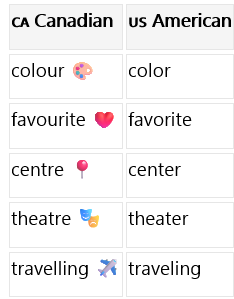
🔤 Spelling Differences
One of the biggest differences you'll see is in spelling ✍️
Canadians often follow British-style spelling, while Americans simplify words:
✨ Tip: In Canada (especially at school or work), it's best to use Canadian spelling!
🏔️ Canadian-Only Expressions
🗣️ Vocabulary Differences
Some everyday words are completely different 👀
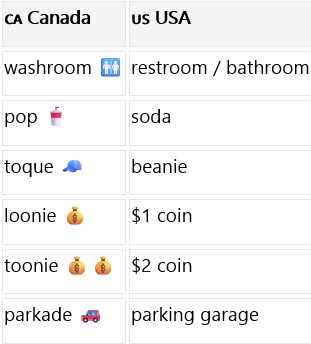
💡 Fun fact: Canadians usually understand American words, but Americans may not always recognize Canadian ones!
These are especially helpful if you want to sound like a local 😄
Double-double ☕
Coffee with 2 creams and 2 sugars.
Timmies 🍩
A nickname for Tim Hortons, Canada's iconic coffee shop.
Eh?
Often used to confirm something, ask for agreement, or make a sentence sound friendlier.
👉 "Nice weather, eh?"
👉 "You're coming with us, eh?"
🔊 Pronunciation Differences
Canadian pronunciation is very similar to American English—but there are a few subtle differences 👂
About → sometimes sounds slightly different to non-Canadians ("a-boat" is a common stereotype! 🚤)
Sorry → many Canadians pronounce it more like "sore-y"
House → can sound slightly different than the American pronunciation 🏠
Process → Canadians often say "PRO-cess", while some Americans say "PRAH-cess"
Schedule → Canadians may use either "SKED-jool" or "SHED-yool," though "SKED-jool" is more common today
✨ These differences are subtle—but they're part of what makes Canadian English unique!
🤔 So... Which Should You Learn?
If you're living or studying in Canada:
✅ Learn Canadian spelling and vocabulary
✅ Understand American English (because it's everywhere online, in movies, and in music)
👉 The good news? The two varieties are very similar, so you'll pick them up quickly!
🌟 Final Thoughts
Canadian English is the best of both worlds 🌎
It blends British spelling with American pronunciation while adding its own unique flavour. ✨
Learning these differences will help you:
🗣️ Communicate more naturally
🤯 Avoid confusion
😎 Sound more like a local
Whether you're ordering a double-double, wearing a toque, or writing colour instead of color, you're experiencing English the Canadian way! 🍁 🦫