
CELPIP Speaking Task 8: Describing an Unusual Situation
CELPIP Speaking Task 8 is one of the most challenging parts of the test because it requires you to react quickly, describe a confusing or unusual situation, and communicate clearly as if you were on a real phone call. In this task, you receive a picture and a scenario, and your job is to describe what you see to someone who cannot see it.
With only 30 seconds to prepare and 60 seconds to speak, having a clear strategy makes all the difference. This guide combines key strategies, evaluation criteria, and practical feedback to help you deliver a high‑scoring response.
🔍 What You Need to Do in Task 8
You must call someone and:
Explain why you’re calling
Describe the unusual scene
Provide clear, specific details
Use natural vocabulary
Ask for help or direction
End the call in a realistic way
🧭 Key Strategies for a Strong Answer
1. Start with a natural phone‑call opening
“Hi, Jill… I’m calling because…”
This immediately shows the examiner you understand the role‑play format.
2. Describe what makes the situation unusual
Talk about the most important or confusing parts of the picture.
3. Focus on what you can clearly describe
If you don’t know a specific term, use a simple phrase like:
“a box‑shaped object”
“a small building with a slanted roof”
“a big round container”
Clear communication matters more than advanced vocabulary.
4. Use simple, natural vocabulary
Avoid forced or robotic words. Everyday English is perfect.
5. End by finishing the phone call
End with a simple, natural closing:
“Okay, let me know what to do. I’ll wait here.”
🎯 CELPIP Scoring Areas
1. Content & Coherence
How well are your ideas organized and developed?
✔ You explained the purpose of the call clearly.
✔ You provided details about the scene
(e.g., beating a drum, making music with glasses, crowd activity).
❗ More descriptive detail is needed to paint a fuller picture.
❗ Speaking pace affected how much detail you could include.
2. Vocabulary
How well do you choose and use words?
✔ Good use of common, clear vocabulary (drum, sticks, glasses, crowd).
✔ Everyday expressions fit the situation well.
❗ Some phrases sounded awkward or unnatural, such as:
“I was going to in the street”
“drum the sticks”
Replacing them with natural phrases improves clarity:
“I was walking along the street”
“He was hitting the drum with sticks”
3. Listenability
How easy is it for the listener to understand you?
✔ Sentences were grammatically clear.
❗ Some pronunciation made listening slightly difficult.
❗ Interjections and self‑corrections interrupted flow.
❗ Tone could be more expressive—especially in exciting or unusual situations.
4. Task Fulfillment
Did you follow the instructions fully?
✔ You addressed the person (e.g., “Katia”).
✔ You included relevant information.
✔ You spoke for the full time.
❗ A more excited or lively tone could match the scenario better.
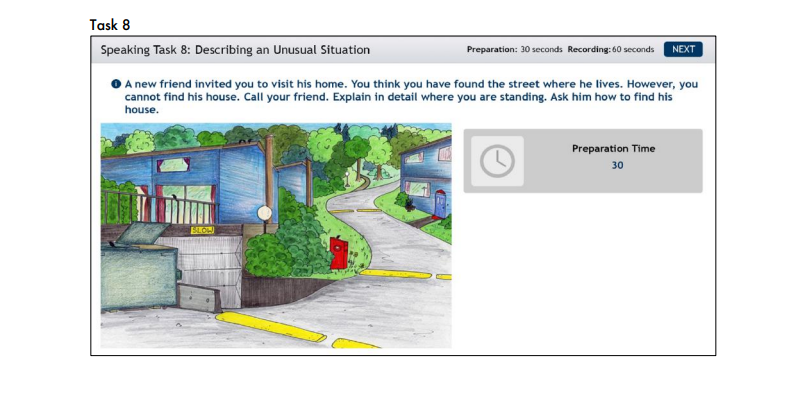
🗣️ Sample 60‑Second High‑Scoring Answer
“Hi, Jill, it’s me. I’m calling because I think I’m on the right street, but I can’t find your house. Let me describe exactly where I am. Right now, I’m standing beside a blue house with a small porch, and across from me there’s another house that looks almost the same. A few steps ahead, there’s a bright red mailbox, and right behind it the road curves to the right and goes slightly uphill. There are lots of trees and bushes around, so everything looks very similar and a bit confusing.
I don’t see any house numbers from here, so I’m not sure whether I should walk up the hill or turn back. Could you tell me which direction I should go from the red mailbox? Or is there another landmark I should look for?
Okay, just let me know what to do. I’ll wait right here until you guide me.”
🌱 Final Tips for Success
Speak naturally, like a real phone call.
Don’t aim for perfection—aim for clarity.
Use simple vocabulary confidently.
Fill the full 60 seconds with steady, organized speaking.
Adjust your tone to match the situation (excited, confused, surprised, etc.).