
IELTS Reading Tips: Matching Headings
Matching Headings is one of the trickiest tasks in the IELTS Reading test. Many learners feel overwhelmed because the headings seem similar and the paragraphs contain lots of detail. But with the right approach and consistent practice, you can dramatically improve your accuracy.
This guide explains the task, shows you proven strategies, shares practical tips, and includes short practice activities with answers.
📘 Understanding the IELTS Matching Headings Task
In this question type, you are given:
Several paragraphs or sections of a passage
A list of short headings
Your job is to match each paragraph to the heading that best represents its main idea
Headings are always general. They summarize the essence of the section, not the small details.
💡 Top Tips for Matching Headings
1. Read all the headings first
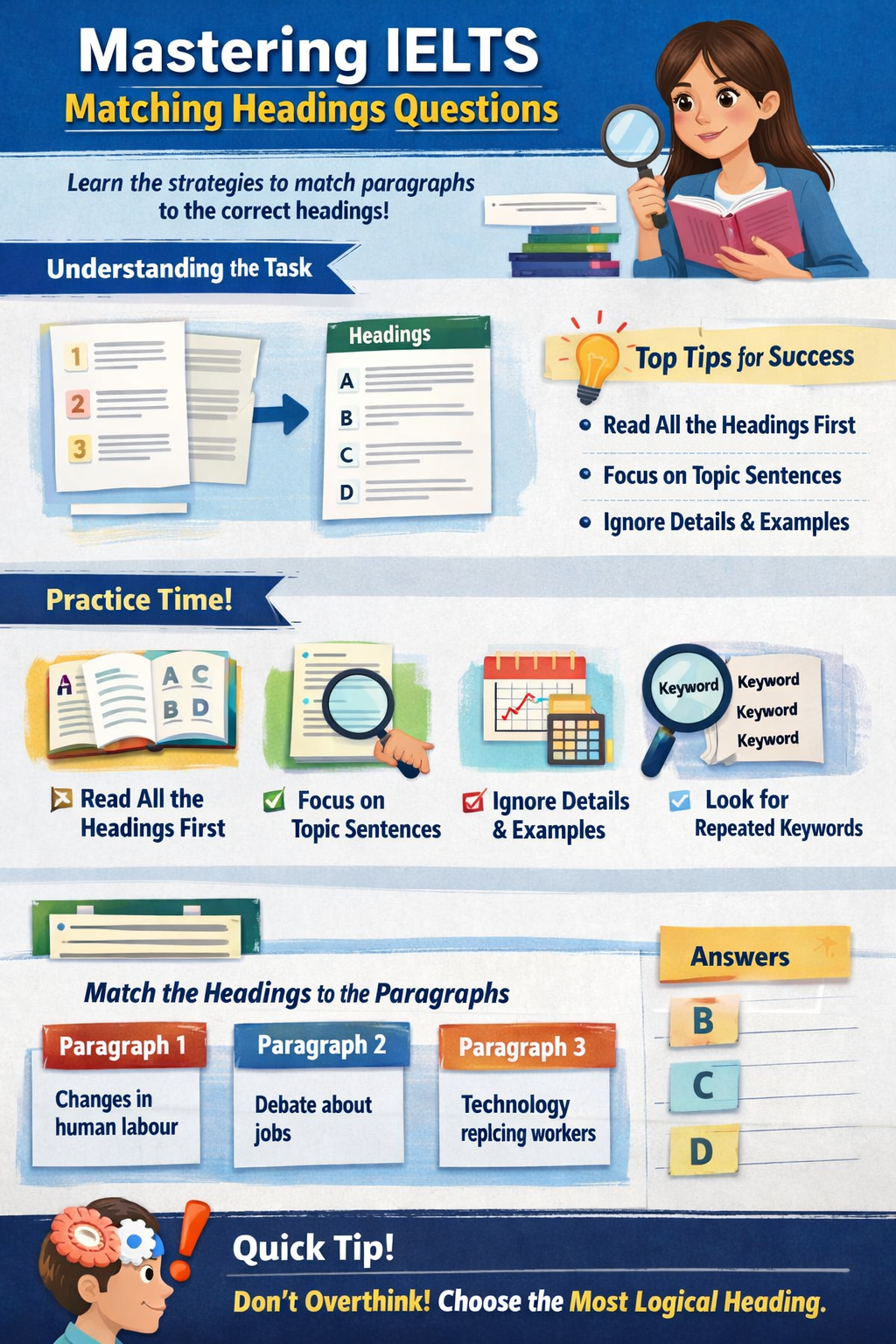
Before reading the passage, skim the headings to build a mental “menu” of possible ideas.
Why it helps:
Your brain becomes primed to recognize main ideas when you skim the paragraphs.
2. Focus on topic sentences
The topic sentence (often the first sentence) introduces the main idea of the paragraph.
Look there first.
3. Ignore examples, dates, and statistics
Details are distractions.
Matching Headings tests your ability to understand the big picture, not specific facts.
4. Look for repeated keywords
If certain ideas or words appear several times in a paragraph, that’s usually the central theme.
5. Match by meaning, not vocabulary
Headings rarely use the same words as the text.
Train yourself to recognize:
Synonyms
Paraphrases
General vs. specific wording
6. Eliminate headings that clearly don’t fit
Cross out headings that have nothing to do with the paragraph. This helps narrow your choices.
7. Leave the hardest ones for last
Often, later paragraphs clarify the overall structure and make earlier ones easier to match.
8. Don’t overthink
Sometimes the simplest heading is the correct one.
Avoid trying to find hidden meanings.
📝 Practice Activity 1: Match the Headings
Headings
A. The unexpected consequences of automation
B. How machines have transformed human labour
C. A debate about the future of employment
D. Examples of technology replacing workers
E. The benefits of technological progress
Paragraph 1
Technological advancement has dramatically changed the nature of human labour. From the industrial revolution up to today's AI‑powered systems, machines have constantly reshaped how people work.
Paragraph 2
Some experts believe automation will lead to a major loss of jobs, while others argue it will create new forms of employment. This disagreement continues among economists and policymakers.
Paragraph 3
Self‑checkout counters, automated manufacturing robots, and AI‑based customer service tools show how technology is increasingly performing tasks once done exclusively by humans.
✔ Answers
B
C
D
📝 Practice Activity 2: Identify the Main Idea
Headings
A. The environmental cost of fast fashion
B. Clothing industry profits and growth
C. Why consumers buy more clothing
D. Ways to reduce clothing waste
Paragraph
Modern consumers purchase clothing more frequently than ever. Low prices, constant new designs, and social media trends encourage many people to treat clothes as disposable, wearing them only a few times before buying something new.
👉 What is the best heading?
✔ Correct Answer: C
The paragraph’s focus is on reasons consumers buy more clothing, not the environmental impact or solutions.
🌟 Final Tips Before the Test
Practice skimming daily — it improves speed and comprehension.
Learn common academic synonyms (e.g., “decline” = “fall,” “reduce” = “cut down”).
Try grouping similar headings together to avoid confusion.
Don’t panic if you’re unsure — choose your best answer and move on.